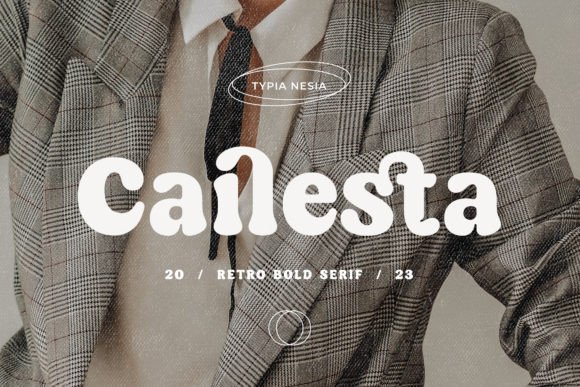
Cailesta: A Chubby Vintage Serif Font for Handmade Brands
If you’ve ever spent hours hunting for a font that feels warm, confident, and unmistakably handmade—something that whispers “summer porch swing” while still holding its own on a candle label or wedding welcome board—you’ll understand why Cailesta landed in my cart and hasn’t left my design toolkit since. It’s not just another bold serif font—it’s a carefully crafted display serif with retro charm, generous curves, and that rare balance of playfulness and polish.
Cailesta is what I call a “smile-on-paper” typeface: chubby letterforms, soft serifs, gentle contrast, and just enough vintage texture to feel nostalgic without leaning into kitsch. The uppercase letters have presence—they pop on signage and product tags—while the lowercase maintains approachability, especially at medium sizes. It’s built for visibility, not subtlety. That means it shines on physical products where legibility matters: think jar labels under café lighting, chalkboard-style signs at farmers’ markets, or foil-stamped gift tags that catch the eye before the hand even reaches for them.
I use Cailesta most often for short, high-impact text—brand names, collection titles, seasonal slogans (“Sunshine & Sage,” “Honey & Thyme”), and event headers. Its bold weight carries beautifully at 24pt and up, and because it’s a display serif (not a text serif), it’s not meant for long paragraphs—but that’s exactly why it works so well for crafters. You don’t need paragraphs on a mug, a sticker sheet, or a printable planner header. You need clarity, character, and instant recognition—and Cailesta delivers all three.
For Cricut and Silhouette users: Cailesta cuts cleanly. I’ve tested it down to 0.25" height on vinyl stickers and 0.375" on kraft paper tags—no broken serifs, no fragile joins. The rounded terminals and open counters help prevent clogging during cutting, and the consistent stroke weight keeps your designs looking crisp, whether you’re weeding by hand or running a batch job. Just avoid scaling below 16pt for printed cards or packaging—if you need smaller body text, pair Cailesta with a clean sans serif (more on that in a moment).
Real-world uses? Let me share what’s worked in my shop: Cailesta on lavender-scented candle labels gives that boutique apothecary vibe without looking overdesigned. On wedding welcome boards, it pairs perfectly with dried florals and linen backdrops—its warmth echoes handwritten elegance but with more consistency across multiple signs. For holiday product packaging, I use it for “Peppermint & Pine” or “Cranberry & Cinnamon” headers—bold enough to read from across a craft fair booth, friendly enough to invite a second look. And yes, it looks gorgeous foil-stamped on matte cardstock for boutique gift tags or engraved on wooden ornaments.
What makes Cailesta especially valuable for sellers is how it supports brand consistency. Because it’s expressive yet restrained, it holds space across different product types—whether you’re designing a digital printable planner cover, an SVG cut file for t-shirts, or a physical sign for your storefront. Customers begin to associate that soft-bold rhythm with your shop. That subtle recognition builds trust. It says, “This isn’t random—it’s intentional, cared for, made with attention.”
Pairing Cailesta thoughtfully expands its range. My go-to combo? Cailesta for headlines + a light, airy sans serif (like Montserrat Light or Poppins Regular) for supporting text. That contrast keeps things modern and readable—especially on social media graphics or digital download previews. For invitations or greeting cards, I sometimes layer it with a delicate script font for names or dates—just one line, never competing. The key is letting Cailesta lead. Its personality is strong enough to carry the visual weight, so supporting fonts should step back, not shout.
Before downloading, check what’s included: Cailesta comes with standard OpenType features—ligatures, stylistic alternates, and basic multilingual support (Latin-based languages including accented characters common in English, French, Spanish, and German). That means “café,” “naïve,” or “jalapeño” render cleanly on your printable menus or bilingual gift tags. File formats are typically OTF and TTF—both fully compatible with Cricut Design Space, Silhouette Studio, Canva, and Adobe apps. No web font files, but you won’t need them for physical product design or digital downloads.
One practical note every seller must know: Cailesta is licensed for commercial use—including physical products, digital printables, SVG files, templates, and client work—as long as you’re not reselling the font file itself. That means you can use it on mugs you sell on Etsy, in Canva templates you license, or on sticker sheets you ship to customers. But you cannot include the .OTF file in a bundle and call it “free fonts for crafters.” Always double-check the license terms when you purchase, but reputable serif font creators (like the designer behind Cailesta) build their licenses with small businesses in mind.
Finally—don’t underestimate how much mood a font sets before a single word is read. Cailesta doesn’t scream. It leans in. It invites. That quiet confidence translates directly to how customers perceive your handmade goods: thoughtful, grounded, full of care. Whether you're designing a summer-themed printable collection, rebranding your soap line, or prepping for holiday market season, Cailesta brings that vintage-chic warmth without sacrificing clarity or craftsmanship.
It’s the kind of serif font that doesn’t ask to be noticed—it simply belongs.